
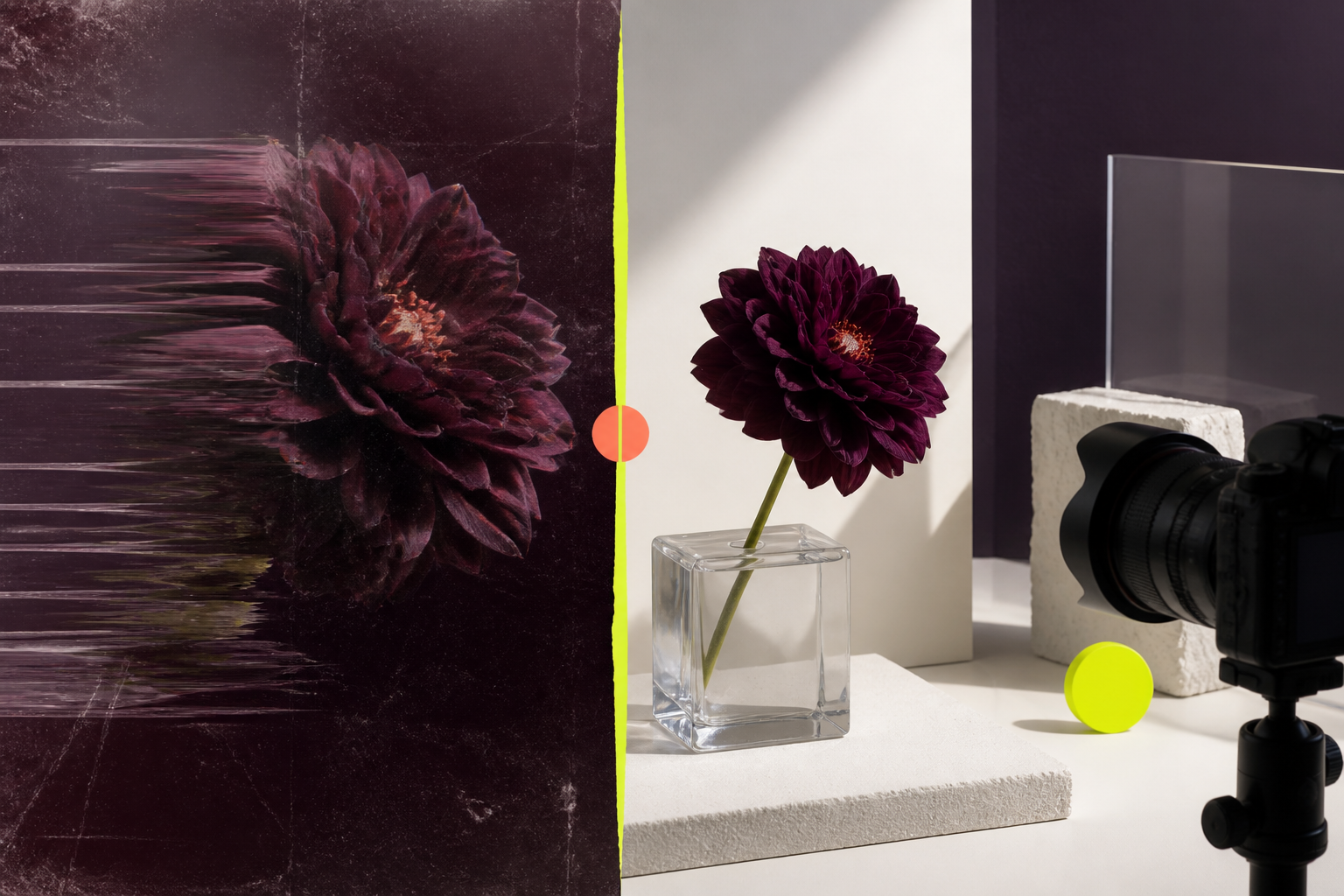
Enhancement can improve a viable source, but it cannot change the original viewpoint, recover unsupported facts or create missing usage rights. A reshoot becomes the better decision when the image must prove something the source cannot reliably show.
Reshoot when truth is the constraint
Choose a new capture when product construction, colour, identity, safety, medical detail or documentary evidence must be accurate and the source does not contain enough information. Generated plausibility is not a substitute for observation.
A reshoot can also provide current context when the product, packaging, team or location has changed. Enhancement of an obsolete image may create a polished but misleading asset.
Reshoot when the required composition is absent
If the campaign needs a new viewpoint, natural interaction, specific shadow, large empty text area or radically different crop, reconstructing the scene may cost more review time than capturing it correctly. List all placements before deciding.
Responsive art direction can require genuinely different compositions for narrow and wide layouts. W3C use cases show why a crop is sometimes a content decision, not only a resolution variant.W3C responsive image use cases ↗
Reshoot when permissions cannot follow the new use
A source may be technically usable but licensed only for an earlier campaign, territory or channel. Consent may not cover meaningful synthetic alteration or a sensitive new context. New production can establish appropriate rights and expectations.
Do not assume AI assistance resolves ownership or consent. The US Copyright Office’s AI materials address US copyright questions, while other rights and jurisdictions require their own analysis.US Copyright Office AI initiative ↗
Compare total production risk, not tool cost
Estimate operator time, specialist review, correction rounds, uncertainty and the cost of a wrong claim. Compare that with planning, capture, retouching and future reuse from a reshoot. A cheap generation can become expensive when every detail needs forensic review.
Run a short viability test before committing to enhancement. If a protected detail fails, stop. A documented stop condition keeps sunk effort from turning into a weak release decision.
Estimate both routes with the same scope
For enhancement, include source search, tests, operator time, specialist verification, correction rounds, delivery variants and the residual risk of an unusable result. For a reshoot, include planning, people, location, capture, retouching, rights and the broader set of future assets it may produce.
Compare the routes against the same placements and deadline. An enhancement quote for one hero crop is not comparable with a reshoot that creates a complete responsive and social library. A fair estimate often changes the apparently cheaper choice.
Consider a small controlled recapture
A reshoot does not always require a large campaign set. A client may capture a product, document or person under a concise technical guide, with remote art direction and a colour or scale reference. This can provide factual detail that the original lacks.
Review a test capture before the full session. Check focus, lighting, perspective, reflections, background separation and enough space for planned crops. A controlled small recapture can then become the authoritative layer inside a wider composite.
Make stopping a recognised production outcome
Write the viability threshold before enhancement begins. Examples include preserving exact label copy, matching approved product geometry or producing a clean crop at final size without invented identity detail. If the test fails, close the route and retain the evidence.
A stop decision protects schedule and trust. Explain which requirement failed and recommend reshoot, redesign, alternate asset or smaller placement. The work is not wasted when it replaces optimism with a clear production choice.
A practical decision table
| Signal | Enhance | Reshoot |
|---|---|---|
| Source truth | Required facts are visible | Required facts are missing |
| Composition | Crop can meet the brief | New viewpoint or action is needed |
| Rights | New use is clearly covered | Permission or consent is insufficient |
Release checklist
- List protected facts
- Check whether source contains them
- Map every destination crop
- Confirm source date
- Confirm licence scope
- Confirm consent context
- Run one viability test
- Estimate review cost
- Set a stop condition
- Document the decision
Common questions
Is a reshoot always more expensive?
No. For high-risk detail or many future formats, one controlled capture can cost less than repeated reconstruction and review.
Can enhancement still support a reshoot?
Yes. It can help plan crops, mood and previsualisation, provided concept output is not mistaken for the final factual image.